
Whitfield County’s Multi-Day Arrest Reports
For multi-day arrest coverage, the FetchYourNews Whitfield arrest reports archive is the clearest source. It is local news, not the sheriff. Posts run in date ranges like July 5 through July 12, 2026, or June 28 through July 5, 2026. That rhythm suggests a weekly or near-weekly cycle. Treat it as a habit, though, not a promise. Call a post WCSO-provided only if it says so. Publication dates are not booking times, and an archive story does not prove anyone is still in custody. For same-day results, the official route sits on Arrests Last 24 Hours.
How to Read the Whitfield Blotter
Work from the report’s own date range and provenance before drawing any conclusion.
- Open the archive and choose a post whose stated range covers the date in question.
- Read the post date separately from each listed booking date.
- Check whether the article identifies WCSO as the source and note which fields actually appear.
- Compare the name and date with WCSO Recent Arrests, Inmates, or Event Search.
- Use the relevant court record for the disposition, since the listed charge is only the booked charge.
A missing name is not the end. P2C events, agency records, court cases, and retained records may still exist on request.
Fields in a Whitfield Arrest Report
The archive's format changes from post to post. Do not expect the fuller field set that P2C supports.
| Field | What it means |
|---|---|
| Date range | The period named by the article, not a guaranteed complete reporting window. |
| Name | An identifier that should be checked with age, date, or another field. |
| Booking date | The date tied to intake, distinct from article publication. |
| Charges | Charges reported at booking. |
| Photo | Use varies by post and cannot be assumed; this page rehosts no booking photos. |
Note: A news copy can be incomplete or stale even when it accurately transcribed the source available at publication.
Official Daily Bulletin Comparison
WCSO's official P2C Daily Bulletin is a separate daily-activity route. It shows no arrest-only multi-day window. The module publishes no fixed cadence or full field list, so keep it distinct from the news archive.
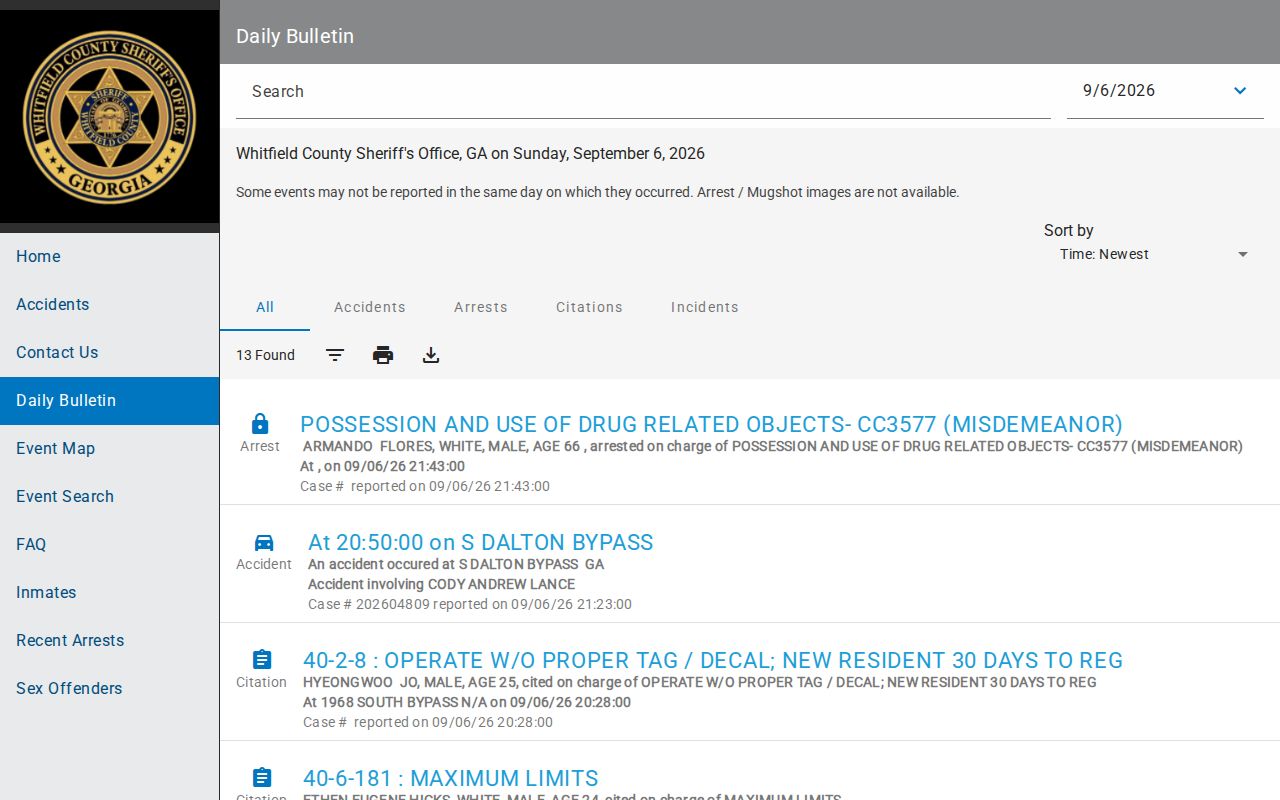
The Daily Bulletin page shows the sheriff's own activity tool. The news archive remains stronger for browsing date ranges. WCSO also runs an official Event Search for arrest, incident, or accident lookups.
Event Search fills the gap after a card disappears. It is still not the final word from a court on a case.
Weekend and Holiday Posting Gaps
No official rule governs weekend or holiday posting. The Sunday-to-Sunday ranges are just an observed pattern in the news archive, not a service promise. Court processing, records-office work, and article publication each run on their own clock. A late post may bundle arrests from days earlier. A weekend arrest can appear in P2C before any report catches up. So a quiet archive page proves nothing. People get arrested without a headline. Search the official current sources first. Wait for a later date-range post, or contact the record custodian for a specific event. The gap matters most around a boundary date that one post's range includes but the next one reports.
Whitfield News Coverage Is Selective
The Dalton Citizen and its Northwest Georgia local page hold historical area-arrest material. The paper follows no fixed mugshot schedule or complete county archive. WDEF's Whitfield County tag runs incident stories as news breaks, not as a booking list. The Georgia Gazette keeps a rolling Whitfield section. That site is commercial and unofficial. Treat it as reporting, not a certified roster.
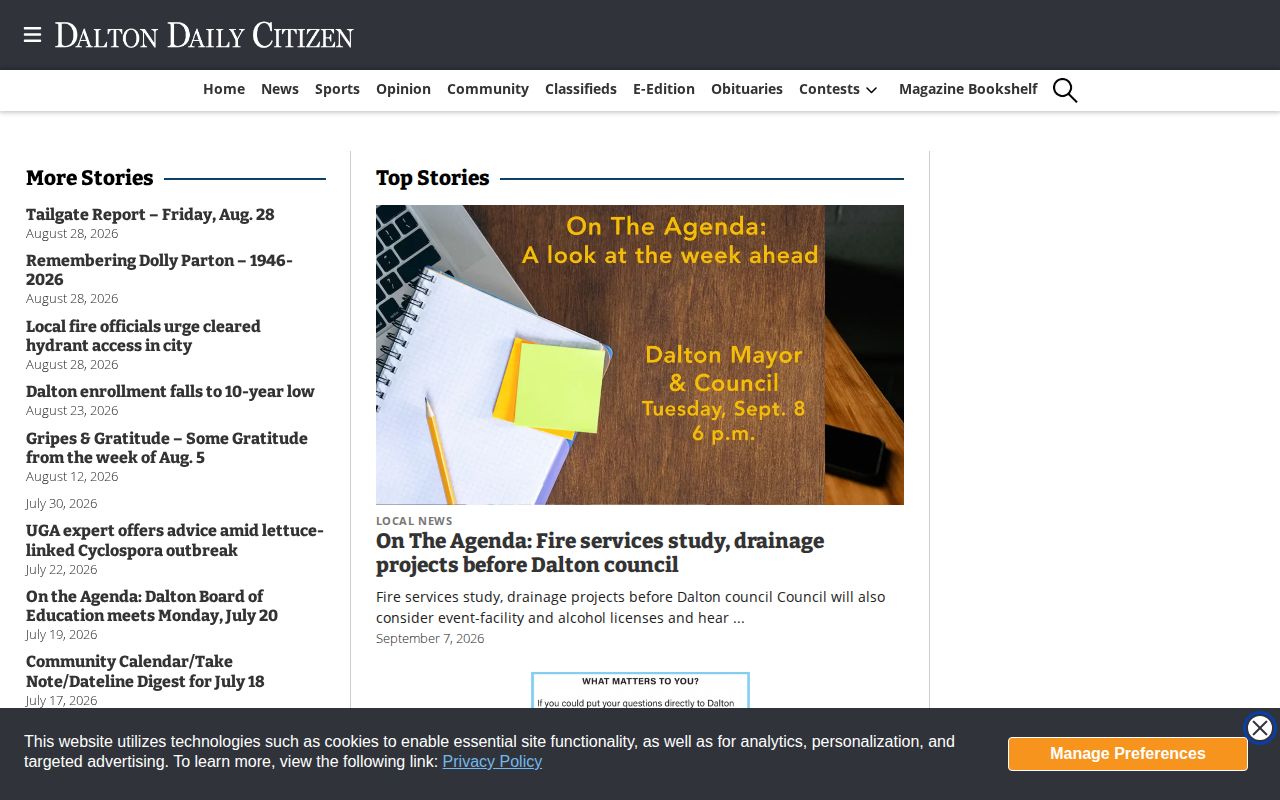
Use local reporting as a discovery lead. Then compare names, dates, charges, and outcomes against WCSO and court records.
Note: Editorial stories may use supplied or file images that are not booking photographs and may cover only selected events.
Archives Beyond the Published Blotter
The news archive paginates and reaches back farther than the live Recent Arrests view. No guaranteed retention endpoint exists, though. Georgia Archives schedules set minimum retention for record categories. They do not control how long a web card or news story stays online. Arrest and Booking Summary Statistics carry a five-year minimum. Other categories follow their own schedules. None of that promises a particular public image survives. When a report disappears, try P2C Event Search before anything else. WCSO Records also answers at 706-876-1520. Ask narrowly for the booking date, agency, case or booking number, booked charges, and any release or court-routing fields. The county form says archived retrieval typically takes one to two weeks, so confirm the current custodian, fee, and delivery method before you submit.
Arrest Counts Are Not Crime Trends
A busy week in a Whitfield blotter does not prove crime climbed. Many forces shape the count. Enforcement focus shifts, agencies transfer cases, and publication choices or data entry can swing what the roster displays. WCSO detention accepts bookings from city, county, state, and occasional federal agencies, so a Whitfield booking is not always a WCSO arrest.
Compare only like periods. One report may span seven days while the next covers a different stretch. Late articles can mix old bookings with new dates. Watch for missing issues, and do not treat archive pagination as a complete statistical dataset of Whitfield County arrests.
Arrest counts track police activity. Transfer rules and booking practice count too. For a real trend question, pull a consistent official statistical series and note its definition and period. For one person, stick with the booking record and whatever the court filed later.
Who booked the person? The county detention page names WCSO, Dalton, Tunnel Hill, Cohutta, and Varnell, plus Georgia State Patrol, GBI, FBI, and occasional federal agencies as booking sources. A report headed with the Whitfield name can hold arrests that began with another office. Ask that office for its incident report.
Older material splits into three questions. Ask the agency for its retained record. Ask the clerk for court-file material. A newspaper archive helps only for context that saw print. Georgia schedules treat booking statistics, warrants, and investigation files as separate categories, so a retention rule for one never governs every photo, article, or web card.
Keep the title, stated range, publication date, and source wording. Those details let Records find the event without turning an unofficial copy into the official file.
Trace a Blotter Entry to Its Source
A multi-day post may crush a booking into a name, a date, and one charge line. Start with the source. Does the post say the material came from WCSO? Next, search the official P2C systems for the same date and person. The public Recent Arrests card can add age, race, gender, physical descriptors, arrest time, location, or an image. Agency, case number, bond, and court fields may stay hidden.
No clear match? Then identify the arresting office. Whitfield County detention houses people arrested by several city, county, state, and occasional federal agencies. WCSO may hold the booking record. Dalton Police or another office may have written the incident report. Ask each custodian for its own record rather than assuming one agency holds the whole file.
The last step is the court record. A blotter charge is what police reported at booking. Later filings can amend or drop it. Court dates and court names stay suppressed in the current Recent Arrests display, so neither the news post nor the booking card shows the full outcome. Keep any case number, since it makes a clerk search precise.
Whitfield Report Publication Patterns
Archive titles span Sunday-to-Sunday date ranges. That shows how selected posts were labeled, nothing more. It does not prove a weekly schedule. A headline's range never promises that every arrest inside those dates made the post. Fields and image use vary by post, and the publisher promises nothing about completeness or retention.
A gap can have several causes. There may be no post, a delay, a changed category, pagination, an omitted booking, or a move to another source. Work backward through the archive first. Then check the official Daily Bulletin and Event Search for the days in question. If the record predates what the web pages expose, WCSO Records and the relevant court remain the durable routes.
Public Record Search
Sponsored Results